Neurobiology
Neural evolution underlying behavioral divergence.
Differences in auditory processing can change which signals a frog treats as conspecific. Temporal features of advertisement calls, including pulse rate and rhythm, are encoded by circuits in the ear and auditory midbrain. If those circuits differ among populations, species recognition can diverge before other traits do. We examine this relationship in chorus frogs whose calls and preferences have already changed under reinforcement. Extracellular recordings and immediate-early gene mapping identify neurons and brain regions that respond to local, foreign, and heterospecific calls. Computational models of auditory circuits are then used to test which cellular parameters can account for the observed behavioral differences, and whether independent populations converge on the same neural solution.
Neurophysiology of auditory neurons underlying mating behaviors
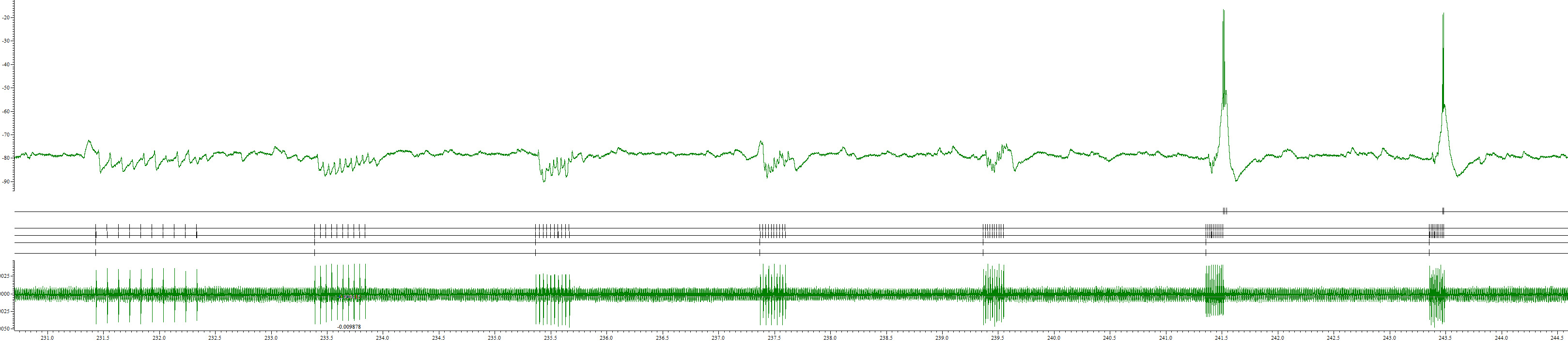
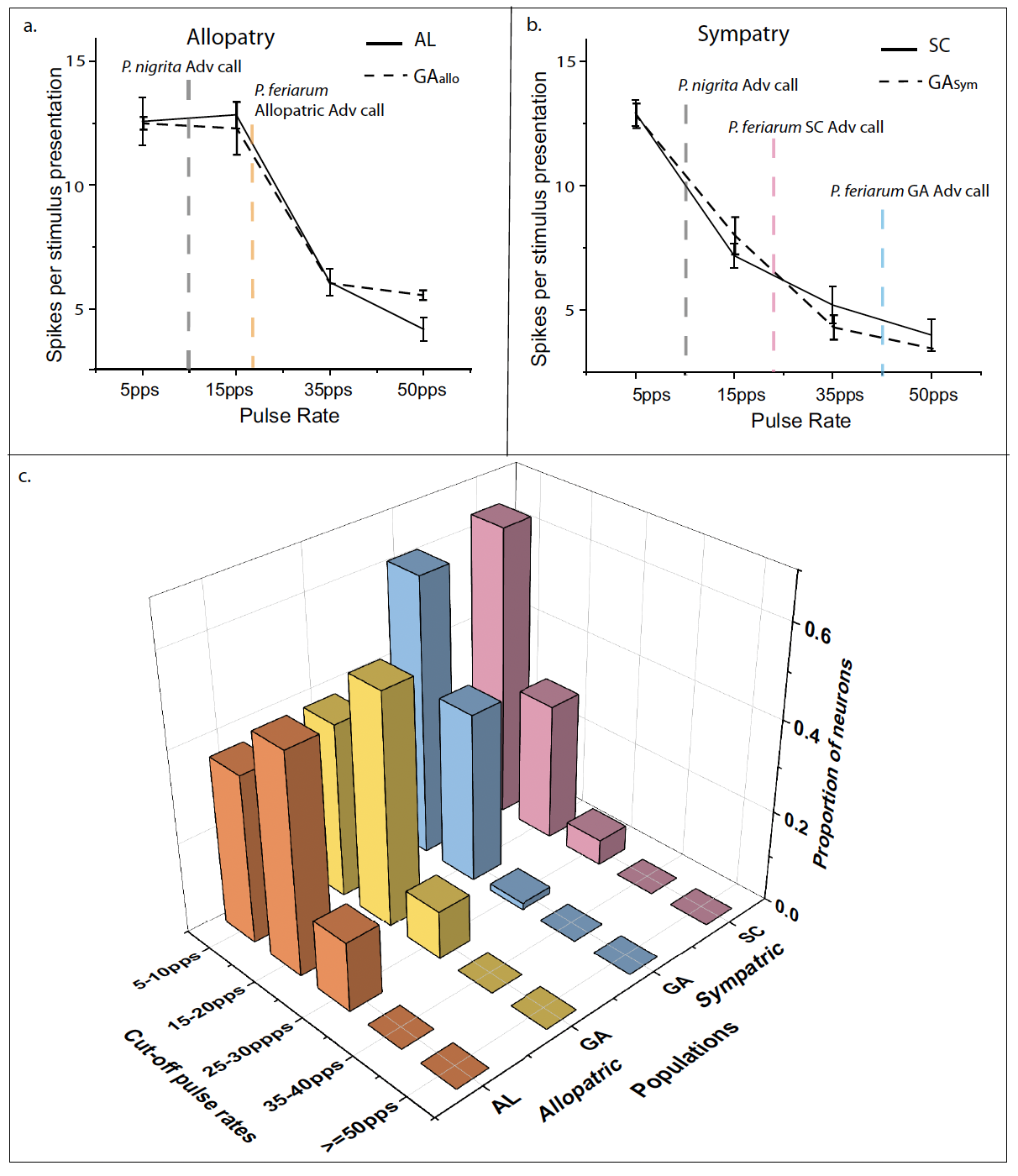
How does temporal selectivity in the auditory midbrain change when populations experience reinforcement? Upland chorus frogs (Pseudacris feriarum) in sympatry produce advertisement calls with faster pulse rates or more pulses than allopatric populations, and females prefer the local signal. We record interval-counting and long-interval neurons from allopatric and sympatric populations to test whether neural tuning matches the local call and reduces responses to heterospecific pulse rates. The work compares pulse-rate and pulse-number selectivity across populations that contact different congeners, asks whether sympatric-like tuning already occurs at low frequency in allopatry, and tests whether reinforcing selection changes the relative abundance of existing neuronal types rather than producing new circuit architectures. These recordings connect standing variation in midbrain processing to the rapid divergence of mate-recognition preferences during speciation.
Selected papers: Mukhopadhyay et al. 2026, Journal of Comparative Physiology AMukhopadhyay et al., In Review, Journal of Comparative Physiology A
Neural substrates of species recognition
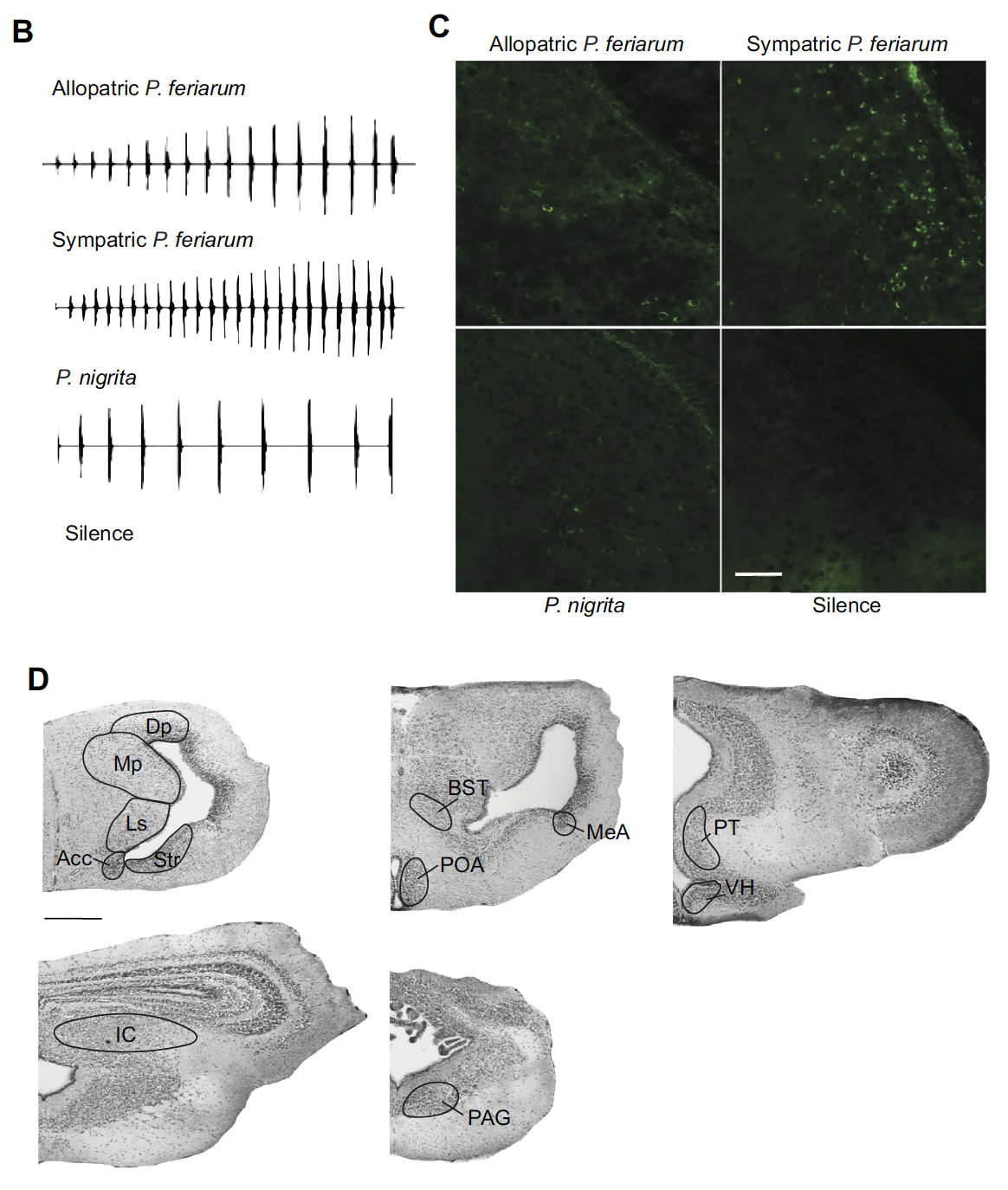
How is species recognition implemented in the brain while mating behaviors are still diverging? Reinforcement has altered advertisement calls and female preferences in P. feriarum, both between species and among conspecific populations. Those behavioral changes can isolate populations before morphological or genetic differences are large. We examine the neural basis of that isolation at three levels. We measure how shifts in female preference contribute to reproductive isolation during the early stages of speciation. We map brain activation in response to conspecific and heterospecific calls and finds that local signals recruit regions involved in spatial navigation and social decision-making, even when motor behavior does not differ among stimuli. We are comparing gene expression in the auditory midbrain (inferior colliculus) across replicate reinforced and non-reinforced populations. The three approaches test whether neural activity and gene expression diverge in parallel with the behavioral isolation produced by reinforcement.
Selected papers: Ochoa et al. 2026, Journal of Experimental BiologyOchoa et al., In Press, Behavioral Ecology and Sociobiology